
Iowa DOT Motorcycle Practice Test 3
Test 3 of 6. Pick an answer for each question to see if it is right and why; your score appears at the end. You need 20 correct answers to pass, the same ratio as the real Iowa test.
- Questions25
- Correct to pass20
- Passing score80%
- Minimum age14 years
-
1. You have a green light and are turning right. Pedestrians are stepping off the curb into the crosswalk you are about to cross. What should you do?
Show answer
Answer B: Wait and let them cross before completing your turn
A green light does not release a turning driver from yielding to pedestrians already in the crosswalk of the street being entered.
-
2. A squirrel darts into your path a short distance ahead. What is normally the safest response?
Show answer
Answer C: Hold your line, brake as much as is safe, and accept hitting a small animal
Swerving without space, or crashing while braking, hurts the rider far more than a small animal does, so stay in your lane and slow as much as traction allows.
-
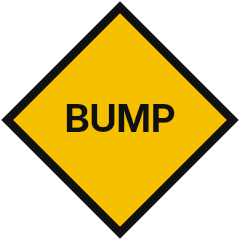
3. How should a driver respond to this sign?
Show answer
Answer C: Slow down before reaching the rough spot and cross it at a steady, low speed
Losing speed before a sharp rise in the pavement keeps the vehicle settled, while braking or accelerating on top of it unsettles the suspension and costs grip.
-
4. Why is it useful to watch the vehicle two or three places ahead of you?
Show answer
Answer C: You get an earlier warning of slowing traffic than brake lights give
Trouble travels back through a line of traffic, so seeing it start several vehicles ahead gives you a head start on braking.
-
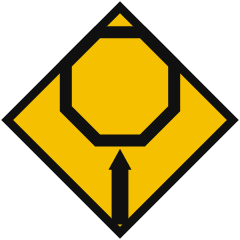
5. On a wet road, how should a driver adjust after passing this sign?
Show answer
Answer B: Start braking earlier, because a slippery surface lengthens the stopping distance
A wet surface lengthens stopping distance, so the extra warning distance should be spent braking gently and early instead of late and hard.
-
6. How can a rider check the action of the front suspension while the motorcycle is stationary?
Show answer
Answer D: Hold the front brake on and push down on the bars to feel the forks move and return
Compressing the forks against the front brake shows whether they move smoothly and return without binding, sticking or making noise.
-
7. What is the purpose of a wide solid white line painted straight across your lane on the approach to an intersection?
Show answer
Answer C: It shows the point where a required stop must be made
A stop line indicates the point at which the stop required by a signal or a stop sign is to be made, ahead of the crosswalk and the intersection.
-
8. You have just ridden over a large object lying in the road. What should you do next?
Show answer
Answer A: Pull over when it is safe and check the tires and rims for damage
An impact can cut a tire, dent a rim or bend a fork without giving any immediate change in how the machine feels, so it deserves a look.
-
9. How many motorcycles may lawfully ride side by side in a single Iowa traffic lane?
Show answer
Answer B: No more than two
Iowa Code section 321.275 states that persons shall not operate motorcycles or motorized bicycles more than two abreast in a single lane.
-
10. What fine does Iowa attach to driving while a license is denied, canceled, suspended, or revoked?
Show answer
Answer D: Not less than two hundred fifty dollars nor more than one thousand five hundred dollars
Iowa Code section 321.218 makes the offense a simple misdemeanor and requires a fine of not less than two hundred fifty dollars nor more than one thousand five hundred dollars.
-
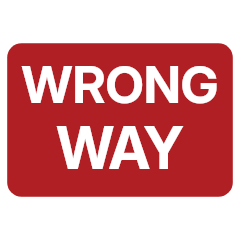
11. At a freeway exit ramp, this sign normally backs up which other regulatory sign posted nearer to the ramp terminal?
Show answer
Answer D: The sign that forbids entering that roadway at all
The two work as a pair at ramp terminals: one keeps drivers from turning in, and this one sits farther along to catch a driver who has already entered.
-
12. On an overhead guide sign, the small exit number panel sits above the left-hand end rather than the right. What does that placement tell you?
Show answer
Answer A: The exit leaves from the left side of the roadway
The exit number plaque is placed on the side from which the ramp leaves, which gives advance notice of the unusual left-hand exit.
-
13. What should a rider confirm about the transmission before starting the engine?
Show answer
Answer B: That it is in neutral, or that the clutch lever is squeezed all the way in
Starting in gear with the clutch engaged can make the motorcycle lurch forward, so the machine must be in neutral or the clutch held in.
-
14. How long is the Iowa revocation for a driver under twenty-one whose test shows .02 or more but less than .08, with no previous revocation?
Show answer
Answer A: Sixty days
Iowa Code section 321J.12 sets a sixty-day revocation for a driver under twenty-one testing at .02 or more but less than .08 with no previous revocation, and ninety days if a previous revocation exists.
-
15. What is the youngest age at which the Iowa DOT may issue an instruction permit?
Show answer
Answer A: 14 years
Iowa Code section 321.180B allows the department to issue an instruction permit to an applicant who is between 14 and 18 years of age.
-
16. Unless posted otherwise, what is the lawful speed in an Iowa business district?
Show answer
Answer A: 20 miles per hour
Iowa Code section 321.285 sets twenty miles per hour in any business district and twenty-five miles per hour in any residence or school district.
-
17. Your vehicle has antilock brakes. What should you never do in an emergency stop?
Show answer
Answer A: Pump the pedal up and down
The system already releases and reapplies the brakes many times a second. Pumping the pedal interrupts it and makes the stop longer.
-
18. Another driver cuts you off and you feel your temper rising. What should you do?
Show answer
Answer A: Take a breath, drop back and let it go, because the whole trip matters more
Retaliation turns a moment of bad driving into a crash, and dropping back costs you only a few seconds.
-
19. Which situation does Iowa law list as requiring a driver to reduce speed to a reasonable and proper rate?
Show answer
Answer D: Approaching and passing through a road work zone
Iowa Code section 321.288 lists approaching and passing through a road work zone among the situations in which a driver must reduce speed to a reasonable and proper rate.
-
20. Which motorcycles must display at least one lighted headlamp whenever they are operated on Iowa highways?
Show answer
Answer B: Motorcycles of model year 1977 or later
Iowa Code section 321.275 requires a lighted headlamp on any 1977 or later model year motorcycle and on any model year motorized bicycle operated on the highways.
-
21. You are approaching an uncontrolled intersection on a residential street where parked cars hide the cross street. What is the correct approach?
Show answer
Answer B: Slow enough to stop and creep out until you can see
Without a sign or signal you still have to be able to yield, and you cannot yield to traffic you have not seen.
-
22. How much clear road do driver manuals say you need before starting a pass at highway speed on a two-lane road?
Show answer
Answer C: Enough to complete the pass and return, roughly ten to twelve seconds of travel
At highway speed the whole maneuver of pulling out, overtaking and returning takes roughly ten to twelve seconds, and every foot of that has to be visible before you start.
-
23. How does Iowa classify a first offense of operating while intoxicated?
Show answer
Answer A: A serious misdemeanor
Iowa Code section 321J.2 makes a first violation a serious misdemeanor, a second an aggravated misdemeanor, and a third or subsequent a class D felony.
-
24. What does Iowa law say about riding a motorcycle between lanes of traffic?
Show answer
Answer C: It is prohibited on Iowa highways
Iowa Code section 321.275 states that a motorcycle or motorized bicycle shall not be operated between lanes of traffic or between adjacent lines or rows of vehicles.
-
25. As a general rule, how far should you travel along a center two-way left-turn lane before you turn?
Show answer
Answer C: Only a short distance, just enough to slow down and wait for a gap
The center lane is for making or preparing a left turn, so you enter it only shortly before the turn and never travel along it as a through lane; several states set a specific limit such as 200 or 300 feet.