
Iowa DOT Permit Practice Test 32
- Questions25
- Correct to pass20
- Passing score80%
- Minimum age14 years
-
1. What is the safest way to deal with a vehicle sitting in your blind spot?
Show answer
Answer A: Slow a little or move ahead so that it is no longer beside you
You cannot control the other driver, but you can change your own speed so that the vehicle is no longer hidden beside you.
-
2. You are very angry after an argument and about to drive. What should you know?
Show answer
Answer A: Strong emotions can impair judgment and attention much like alcohol
Anger, grief and stress pull attention inward and encourage risk taking. Give yourself time to settle down before getting behind the wheel.
-
3. Where may an open or unsealed container of an alcoholic beverage legally be carried in an Iowa passenger vehicle?
Show answer
Answer A: In the trunk, or behind the last upright seat if the vehicle has no trunk
Iowa Code section 321.284 bars open containers from the passenger area, including the glove compartment, but allows transport in the trunk or behind the last upright seat when there is no trunk.
-
4. In the code that governs pavement markings, what does a double line stand for?
Show answer
Answer B: A maximum restriction
The marking code is consistent: a double line means the strongest restriction, a solid line discourages or forbids crossing, and a broken line is permissive.
-
5. Once you have parallel parked, how close to the curb should your wheels be?
Show answer
Answer C: Within the distance your state allows, commonly 12 to 18 inches
Parking close to and parallel with the curb keeps the vehicle out of the traffic lane without damaging the tires; each state sets the exact maximum, usually 12 inches and 18 inches in some states.
-
6. What is true about driving away from a crash you were involved in?
Show answer
Answer B: It is a serious offense, even if the other driver has driven away too
Leaving the scene is a criminal offense in every state, and the behavior of the other driver does not excuse it.
-
7. At what alcohol concentration does a driver aged 21 or older commit operating while intoxicated in Iowa?
Show answer
Answer C: .08 or more
Iowa Code section 321J.2 defines operating while intoxicated to include operating a motor vehicle while having an alcohol concentration of .08 or more.
-
8. You are turning left from a divided highway through a median opening into a business on the other side. Who has the right of way?
Show answer
Answer C: The traffic on the roadway you are crossing
Turning through a median opening means crossing the opposite roadway, so you yield to all traffic on it before you go.
-
9. You are overtaking in a short passing lane on a two-lane road and it is about to end. What must you do?
Show answer
Answer A: Finish the pass and move back to the right before it ends
The added lane ends and the traffic returns to a single lane in each direction, so the pass has to be complete before the pavement runs out.
-
10. The left-turn signal facing you shows a flashing yellow arrow. What does it mean?
Show answer
Answer C: You may turn left after yielding to oncoming traffic and to pedestrians
A flashing yellow arrow permits a left turn but gives no protection, so you must yield to oncoming vehicles and to people in the crosswalk.
-
11. You are traveling beside another vehicle on a multilane highway at nearly the same speed. Why is this a poor position?
Show answer
Answer B: You may be sitting in that driver's blind spot with nowhere to go if they move over
Driving alongside removes your side escape route and often puts you where the other driver cannot see you. Speed up or drop back to open space beside you.
-
12. Travelling at about 55 mph on dry pavement, roughly how much room does an average car need to perceive, react and stop?
Show answer
Answer D: About 300 feet, close to the length of a football field
Reaction distance plus braking distance at 55 mph comes to roughly 300 feet on good dry pavement, and considerably more on a wet or loose surface.
-
13. A child seat was in the car during a moderate crash. What should be done with it?
Show answer
Answer A: Replace it, because a seat that has been through a crash may be weakened
Crash forces can damage a seat in ways you cannot see, so a seat involved in anything but the mildest crash is replaced.
-
14. Why is standing water across a road dangerous even when it looks shallow?
Show answer
Answer B: It can hide a washed out roadbed, a deep hole or a missing cover
You cannot see the surface under the water, and floods commonly wash the roadbed away or lift covers off drains.
-
15. Unless posted otherwise, what is the lawful speed in an Iowa suburban district?
Show answer
Answer C: 45 miles per hour
Iowa Code section 321.285 sets forty-five miles per hour in any suburban district, alongside twenty in a business district and twenty-five in a residence or school district.
-
16. How long is the Iowa revocation for a driver under twenty-one whose test shows .02 or more but less than .08, with no previous revocation?
Show answer
Answer A: Sixty days
Iowa Code section 321J.12 sets a sixty-day revocation for a driver under twenty-one testing at .02 or more but less than .08 with no previous revocation, and ninety days if a previous revocation exists.
-
17. What is the correct technique for backing a vehicle straight?
Show answer
Answer B: Check behind the vehicle before getting in, then turn and look through the rear window while backing slowly
Mirrors and cameras leave gaps close to the vehicle, so walk behind it first, then turn in your seat for a direct view and keep the speed low enough to stop instantly.
-
18. How does eating a large meal before drinking affect impairment?
Show answer
Answer D: It slows absorption but the alcohol still reaches the blood and impairs you
Food delays how quickly alcohol enters the bloodstream, which can make the peak arrive later, but all of the alcohol is eventually absorbed.
-
19. How far ahead should you normally be looking as you drive?
Show answer
Answer C: About 12 to 15 seconds ahead, well beyond the vehicle in front
Looking that far down the road lets you see a problem developing and slow smoothly, instead of discovering it in time only for hard braking.
-
20. What must an Iowa insured do if the coverage is canceled before the date printed on the coverage card?
Show answer
Answer D: Destroy the card
Iowa Code section 321.20B requires the person to whom the financial liability coverage card was issued to destroy the card when coverage is canceled or terminated before the expiration date shown on it.
-
21. A driver in the left lane of a freeway realizes only when level with this sign that the ramp beside it is the one they need. What is the correct action?
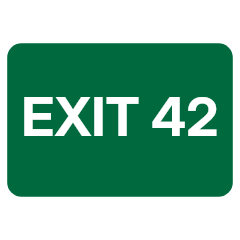
Show answer
Answer A: Carry on to the next interchange and turn back from there
There is no safe way back to a ramp once it has been reached from the wrong lane, so the driver keeps going to the next interchange, where the ramps are built for that movement.
-
22. Someone has stepped into a marked crosswalk in the middle of a block ahead of you. What should you do?
Show answer
Answer A: Slow down, stop before the markings and let the person cross the street
A marked mid-block crosswalk carries the same duty as one at a corner: give way to the person crossing, stopping if that is what letting them cross safely takes.
-
23. What does the implied consent law mean for drivers?
Show answer
Answer D: By driving, you have agreed to a chemical test if lawfully arrested for impaired driving
Holding a license and driving on public roads is treated as consent to breath, blood or urine testing when an officer has grounds to arrest you. Refusing normally brings its own license penalties.
-
24. What is the rule about leaving a child or a pet in a parked vehicle?
Show answer
Answer A: Never do it; the inside can turn deadly hot very quickly
The inside of a parked vehicle heats far faster than the air outside, and cracking a window does not prevent it, so a child or animal must never be left there.
-
25. A row of solid white triangles points toward you across your lane. What does it mark?
Show answer
Answer A: The place to yield to traffic or people ahead
A yield line of triangles shows drivers exactly where to give way, and it is used at roundabouts and at midblock crosswalks.