
Iowa DOT Permit Practice Test 31
- Questions25
- Correct to pass20
- Passing score80%
- Minimum age14 years
-
1. You are parking on a hill where there is no curb, whether facing up or down. Which way should the front wheels point?
Show answer
Answer B: Toward the shoulder, so the vehicle would roll away from the traffic lanes
With no curb to stop the vehicle, the wheels are turned toward the edge of the road so that a runaway vehicle leaves the roadway instead of entering it.
-
2. Besides the traffic behind you, what else must you check before moving into the next lane?
Show answer
Answer D: That there is room ahead in the new lane for your normal following distance
Moving into a gap that is too short leaves you tailgating the vehicle ahead with a vehicle close behind you.
-
3. What does it mean to cover the brake, and when should you do it?
Show answer
Answer B: Hold your foot over the brake pedal without pressing it when a hazard seems likely
Covering the brake cuts reaction time when you expect trouble, such as near children, parked cars or a vehicle that may pull out. Riding the brake wears it out and confuses drivers behind you.
-
4. A regulatory sign reads TURN ON HEADLIGHTS NEXT 15 MILES. What does it require?
Show answer
Answer C: Low beam headlights on for that stretch, day or night
Such a section is signed where a road is hard to see along, and the requirement is to run headlights, not just daytime running lamps, through the whole stretch even in bright daylight.
-
5. Besides motorist services and tourist information, a blue sign background is also used for
Show answer
Answer B: evacuation route signing
Blue is assigned to road user services, tourist information and evacuation routes, so hurricane and other evacuation routes are signed in blue.
-
6. You are stopped at a red light waiting to turn right where the turn is allowed. Besides traffic from the left, what must you check?
Show answer
Answer D: Both crosswalks, and anyone approaching along your right side
A right turn on red crosses the crosswalk in front of you and enters the one on the cross street, and cyclists often approach along your right.
-
7. You have a green light and an ambulance with lights and siren enters the intersection against its red. What should you do?
Show answer
Answer B: Stop and let the ambulance go through
An emergency vehicle answering a call may cross against a red, and every other driver yields to it whatever their own signal shows.
-
8. Which warning sign keeps its yellow background even when it is used inside a work zone?
Show answer
Answer D: The grade crossing advance warning sign
The round grade crossing advance warning sign keeps its black legend on yellow inside temporary traffic control zones because the railroad hazard it describes is not temporary.
-
9. You are traveling beside a solid white lane line. What does it tell you?
Show answer
Answer B: Crossing it is discouraged or prohibited, so stay in your lane
A solid white line separates lanes going the same direction where lane changing is discouraged or prohibited, such as where a through lane meets a mandatory turn lane.
-
10. You realize you have driven several miles without remembering any of it. What kind of distraction is this?
Show answer
Answer C: Cognitive distraction, because your mind was not on driving
Daydreaming or being lost in thought is a cognitive distraction. Your eyes may be on the road, but your brain is not processing what they see.
-
11. A small yellow plaque showing a speed number below a curve warning sign gives
Show answer
Answer C: the speed recommended for the condition being warned about
The advisory speed plaque belongs to the warning series and states the speed judged safe for the condition ahead under good circumstances, not a regulatory limit.
-
12. Under Iowa's implied consent law, who decides whether breath, blood, or urine is tested?
Show answer
Answer D: The peace officer, although refusing the blood test alone is not treated as a refusal
Iowa Code section 321J.6 lets the peace officer determine which of the three substances is tested, and provides that a refusal of a blood test is not a refusal because another test must then be offered.
-
13. At what level of property damage to one person does Iowa require an uninsured driver to deposit security after a crash?
Show answer
Answer D: One thousand five hundred dollars or more
Iowa Code section 321A.5 requires the department to suspend the license and registrations unless security is deposited after a reported crash causing injury, death, or damage to one person's property of one thousand five hundred dollars or more.
-
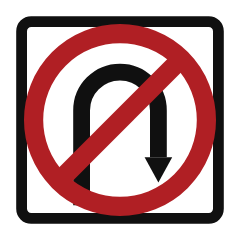
14. A driver who wants to reverse direction arrives at this sign. What is allowed?
Show answer
Answer C: Going on and reversing direction only where the maneuver is permitted
The restriction removes that maneuver at that spot entirely, so the driver has to continue and turn the vehicle around at a place where it is not prohibited.
-
15. Why should you not switch the engine off while the vehicle is still moving fast?
Show answer
Answer B: You lose power steering and the steering may lock
With the engine off the steering becomes very heavy and on many vehicles the column can lock, so shift to neutral first and only shut down once stopped.
-
16. You have turned right into the nearest lane but you need the left lane soon. When should you move over?
Show answer
Answer A: After the turn is finished, once you have checked mirrors and blind spot
Complete the turn in the proper lane first, then make a normal lane change with mirror and blind spot checks once you are established on the new street.
-
17. Why should the washer reservoir hold proper washer fluid rather than plain water in winter?
Show answer
Answer D: Water freezes and it leaves you with no way at all to clean the glass
Washer fluid contains antifreeze, so it still works in the cold, whereas water freezes in the reservoir and the lines.
-
18. What is the minimum period of confinement for a first Iowa operating while intoxicated conviction?
Show answer
Answer B: Forty-eight hours
Iowa Code section 321J.2 sets a minimum period of imprisonment in the county jail of forty-eight hours for a first offense, up to a maximum of one year.
-
19. A curb sign reads No Standing. What does it allow you to do?
Show answer
Answer B: Stop only long enough to pick up or drop off passengers
No Standing bars waiting for any purpose except the brief moment needed to let passengers in or out, which is stricter than No Parking.
-
20. Is it safe to check your phone while stopped at a red light?
Show answer
Answer B: No, you may miss the signal change and hazards around you
Attention does not return instantly when the light changes, and emergency vehicles, pedestrians or a rear-end threat can appear while you are stopped. Stay focused on the road.
-
21. A motorcycle ahead of you has its turn signal blinking but continues straight through several intersections. What is the likely explanation?
Show answer
Answer D: Motorcycle signals often do not cancel themselves after a turn
Many motorcycle turn signals are not self-cancelling, so a rider may leave one on by mistake. Wait until the rider actually starts to turn before you act on the signal.
-
22. On a long, straight highway you feel your attention fading. What helps you stay alert?
Show answer
Answer A: Keep your eyes moving, scan mirrors and signs, and take regular breaks
Staring at one point brings on highway hypnosis. Active scanning keeps the mind engaged, and a break every couple of hours restores alertness.
-
23. What is threshold braking?
Show answer
Answer C: Braking hard but staying just short of locking the wheels
A rolling tire grips better than a sliding one, so the shortest stop comes from pressure held just below the point where the wheels lock.
-
24. A yellow diamond showing two vertical arrows, one pointing up and one pointing down, warns that
Show answer
Answer A: the road ahead carries traffic in both directions
The two-way traffic sign warns that the roadway ahead is not divided and that vehicles will be coming from the opposite direction.
-
25. When are the hazard warning lights properly used?
Show answer
Answer A: When your vehicle is stopped or barely moving and is a hazard
Hazard lights warn that your vehicle is an obstruction; they do not authorize illegal parking and they hide your turn signals while driving.