
Iowa DOT Motorcycle Practice Test 54
- Questions25
- Correct to pass20
- Passing score80%
- Minimum age14 years
-
1. Your low beams light about 250 feet of road, but at your speed you would need more than that to stop. What is that called?
Show answer
Answer D: Overdriving your headlights
When your stopping distance is longer than the stretch of road your headlights show, you cannot react to anything you finally see. Slow down until you can.
-
2. The circular sign shape is reserved for which warning?
Show answer
Answer C: Advance warning of a highway-rail grade crossing
A round yellow sign with a black X and the letters RR is the grade crossing advance warning sign, and the circular outline is used for no other message.
-
3. You will leave your vehicle for several hours after dark. Where is the best place to park it?
Show answer
Answer D: In a well-lit spot with people and cameras nearby
Light, passing people and cameras all discourage theft and make your own return to the vehicle safer.
-
4. Your vehicle breaks down on a busy highway. What is the safest course of action?
Show answer
Answer D: Get it as far off the roadway as possible, switch on the hazard lights and keep clear of the traffic lanes
A vehicle left in or beside a travel lane is a hazard, so move it well off the road, make it conspicuous with hazard lights and keep yourself away from passing traffic.
-
5. You are driving on a divided highway and see a solid yellow line along the left side of your lanes. What does it tell you?
Show answer
Answer D: It marks the left edge of the roadway for your direction
On a divided highway or a one-way roadway, the left edge of the traveled way is marked with a solid yellow line.
-
6. You are approaching a traffic light that has been green for a long time. How should you treat it?
Show answer
Answer C: Expect it to change and be ready to stop
A light that has been green for a while is called a stale green light. Cover the brake and decide in advance where you could still stop safely.
-
7. You are about to pull out from a stop sign. Which scanning habit is correct?
Show answer
Answer A: Look to the left, then to the right, then to the left again before moving
Traffic from the left reaches you first, and a second look left catches anything that arrived while you were looking right.
-
8. The trapezoid sign shape is associated with
Show answer
Answer C: recreational and cultural interest area signing
The trapezoid is used for recreational and cultural interest area guide signs and for national forest route markers.
-
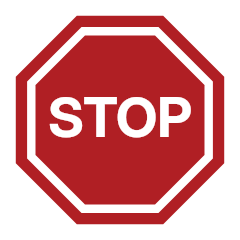
9. A stop line is painted across the pavement at this sign. Where must the vehicle come to rest?
Show answer
Answer A: Behind the stop line, with no part of the vehicle across it
The vehicle must halt behind the stop line; where no line is painted the driver stops before the crosswalk, and where there is neither, before entering the intersection.
-
10. Your left-turn lane shows a flashing yellow arrow. What does that indication allow?
Show answer
Answer B: A left turn after yielding to oncoming traffic and to pedestrians
A flashing yellow arrow marks a permissive left turn: the movement is allowed, but oncoming vehicles and pedestrians keep the right-of-way.
-
11. Under Iowa law, what must a motorcycle have before it may legally carry a passenger?
Show answer
Answer A: A seat designed for more than one person or an extra attached seat, plus footrests for the passenger
Iowa Code section 321.275 permits a passenger only on a motorcycle designed to carry more than one person, on a regular seat designed for two or another firmly attached rear seat, and the motorcycle must have footrests for the passenger.
-
12. At a stop sign with a painted stop line and a crosswalk, where must you stop?
Show answer
Answer D: At the stop line, before it and before the crosswalk
You stop at the stop line first, and only if there is no stop line do you stop before the crosswalk, and only if there is neither do you stop before entering the intersection.
-
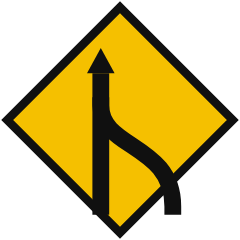
13. What does this sign warn a driver about?
Show answer
Answer A: Traffic from another roadway will enter the same lane ahead
Two traffic streams come together into one lane beyond this point, so drivers on both roadways have to adjust speed and spacing to fit together.
-
14. How can the vehicle ahead of you help you read the road at night?
Show answer
Answer A: Its headlights light the road further ahead than yours can reach
The lights of the vehicle ahead reach beyond your own beam, so its brake lights and the way it moves warn you about holes, turns and hazards you cannot yet see.
-
15. How does braking distance change if you double your speed?
Show answer
Answer D: It grows much more than twice as long
Braking distance increases with the square of speed, so doubling speed roughly quadruples the distance needed to stop.
-
16. What effect does low tire pressure have on a motorcycle?
Show answer
Answer C: It makes steering, braking and general handling worse
An underinflated tire changes shape under load, which makes the motorcycle steer heavily and respond unpredictably.
-
17. You are about to carry a passenger for the first time. Where should you begin?
Show answer
Answer C: In a quiet area away from traffic, at low speed
A passenger changes balance, braking and steering feel, and those differences are best learned somewhere there is nothing else to deal with.
-
18. You must cross tracks or pavement seams that run in nearly the same direction as your path of travel. What should you do?
Show answer
Answer C: Move far enough away to cross at an angle of at least 45 degrees, then turn sharply across
A shallow crossing lets the groove catch and steer the front wheel, so the rider sets up to cross at 45 degrees or more and makes one deliberate turn across it.
-
19. You are turning left from a one-way street onto another one-way street. Which lane should you use?
Show answer
Answer B: Turn from the far left lane into the far left lane of the new street
The general turning rule is to turn from the lane nearest the direction of the turn into the nearest lane of the new roadway, which on a one-way to one-way left turn means far left to far left.
-
20. A vehicle coming toward you has drifted into your lane. What should you do?
Show answer
Answer D: Slow down, sound the horn, flash your lights and steer to the right if possible
Moving right gives the other driver space to recover and keeps you out of the lane they are most likely to return to. Braking reduces the force of any impact.
-
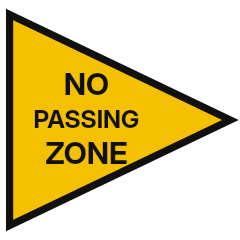
21. A driver is thinking about overtaking a slower vehicle and sees this sign a short distance ahead. What does it mean for that pass?
Show answer
Answer B: The pass must be finished before the restricted section begins
The sign marks the start of a section where passing is prohibited, so a driver may not be on the left side of the road beyond it; any pass has to be completed before that point or not started at all.
-
22. Your lane is ending ahead in slow, heavy traffic and drivers in the next lane are already bumper to bumper. What is the recommended way to merge?
Show answer
Answer C: Take turns, one vehicle from each lane at the merge point
Alternating one for one at the merge point keeps both lanes moving and is the safest way to combine slow traffic.
-
23. The temperature gauge climbs toward the red while you sit in slow moving traffic. What should you do?
Show answer
Answer A: Get out of the traffic as soon as it is safe and let the engine cool
A stationary motorcycle gets almost no airflow through the engine or radiator, so the cure is to stop creeping along in traffic and let it cool.
-
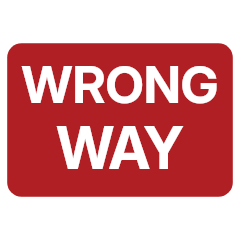
24. This sign comes into view ahead of a driver who has already started along a ramp. What should the driver do?
Show answer
Answer B: Pull clear where it is safe, then turn around and leave the ramp traveling properly
The driver is traveling against the legal flow, so the safest response is to stop clear of the lanes, turn the vehicle around and get off the ramp before meeting traffic head on.
-
25. A driver moves into the space you were keeping ahead of you. What should you do?
Show answer
Answer D: Ease off and rebuild the gap in front of you
Losing a following gap is common in traffic; the answer is simply to drop back and recreate it rather than drive too close.