
Iowa DOT Motorcycle Practice Test 39
- Questions25
- Correct to pass20
- Passing score80%
- Minimum age14 years
-
1. A sign reads REDUCED SPEED LIMIT AHEAD. What does it tell you?
Show answer
Answer D: A lower limit begins further along the road
The sign gives advance notice so a driver can slow gradually, and the new figure takes effect at the speed limit sign that follows.
-
2. When should speed be adjusted for a curve?
Show answer
Answer B: Before entering the curve
Slowing before the curve lets the rider hold a steady or slightly increasing throttle through it, which settles the suspension and keeps traction predictable.
-
3. Which of these is never a legal place to park?
Show answer
Answer C: In a crosswalk, on a sidewalk or within an intersection
Crosswalks, sidewalks and intersections must stay clear so that pedestrians can cross and drivers can see approaching traffic.
-
4. Why is the road often most slippery during the first few minutes of rain after a long dry spell?
Show answer
Answer C: Oil and dust on the surface mix with the water into a slick film
Oil drippings and road dust build up on dry pavement, and the first light rain lifts them into a slippery film before heavier rain washes it away.
-
5. How should a load be distributed between the two saddlebags?
Show answer
Answer B: Evenly, so the weight is balanced from side to side
An uneven load pulls the motorcycle toward the heavy side and makes it behave differently in left turns than in right turns.
-
6. From which lane should a permitted U-turn be started?
Show answer
Answer A: The lane nearest the center line, the same one used for a left turn
A U-turn is begun from the far left lane for your direction, the same position used for a left turn, so you do not cut across traffic beside you.
-
7. How should the brake light be checked before a ride?
Show answer
Answer D: Confirm that the hand lever and the foot pedal each switch it on
Many motorcycles use a separate switch for each brake control, so both the lever and the pedal have to be tested one at a time.
-
8. The lane you are in has a right-turn-only arrow painted on the pavement. What must you do?
Show answer
Answer C: Turn right, because a lane-use arrow is a legal requirement
Lane-use arrows painted on the pavement are regulatory markings, so a driver in that lane must travel in the direction shown.
-
9. What do the numbers on a pedestrian countdown display show?
Show answer
Answer A: The seconds remaining to finish a crossing already under way
The countdown runs during the pedestrian change interval and shows how many seconds are left before the crossing time ends.
-
10. How should a group decide how often to stop for fuel?
Show answer
Answer A: By the range of the machine with the smallest fuel tank
Planning around the smallest tank keeps the group from splitting up when one rider has to leave the route to look for fuel.
-
11. Why should a rider avoid coasting to a stop with the transmission in neutral?
Show answer
Answer C: Engine braking is lost and so is the ability to accelerate out of trouble
Staying in gear keeps engine braking working and leaves the rider able to power away from a hazard instead of hunting for a gear first.
-
12. What must you check about a load before riding away with it?
Show answer
Answer C: That it does not cover the tail light, the brake light or the signals
Luggage that hides the lights leaves drivers behind with no warning that the motorcycle is slowing or turning.
-
13. Without a depth gauge, how can a rider tell that a tire has worn out?
Show answer
Answer A: The tread has worn down level with the wear bars set into the grooves
Wear bars are molded across the bottom of the tread grooves, and once the tread surface reaches them the tire has no usable depth left.
-
14. You park at the roadside on a hill, facing downhill. What keeps the motorcycle from rolling away?
Show answer
Answer D: Leaving it in first gear with the front wheel turned toward the curb
A motorcycle has no parking brake, so the transmission left in gear stops the wheel turning and the front wheel turned into the curb blocks any roll.
-
15. How does marijuana affect a driver?
Show answer
Answer C: It slows reaction time and impairs judgment of time and distance
Marijuana impairs coordination, attention and the ability to judge speed and distance. Driving while impaired by it is illegal everywhere, even where its use is legal.
-
16. You have turned onto a ramp at night and your headlights pick out large white arrows painted on the pavement pointing straight back at you. What do they mean?
Show answer
Answer C: You are traveling against the flow and must turn back
Wrong-way arrows are laid so that a driver going the correct way never sees them head on, so an arrow pointing at you means you are on the ramp backwards.
-
17. A reduced speed limit posted with this sign and a plaque giving hours is in force

Show answer
Answer C: during the hours shown on the plaque, or while the beacon is flashing
A school speed limit applies during the periods stated on the plaque or while the attached beacon flashes, and the regular limit governs outside those periods.
-
18. Why are ordinary denim jeans a poor choice for riding?
Show answer
Answer C: They wear through in a slide, giving little abrasion protection
Light denim abrades away in a fraction of a second on pavement, while leather or purpose made textile gear stays intact long enough to protect the skin underneath.
-
19. What is the correct sequence for shifting into a higher gear?
Show answer
Answer C: Roll off the throttle, squeeze the clutch, lift the lever, ease the clutch out
Closing the throttle as the clutch comes in, then easing the clutch out as the throttle is reopened, keeps the change smooth and the chassis settled.
-
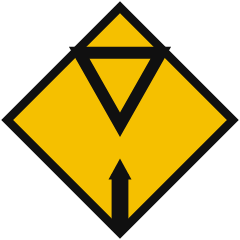
20. What will the driver have to do at the point this sign refers to?
Show answer
Answer C: Slow down and let conflicting traffic go first, stopping if that is what it takes
Further along, the driver has to let conflicting traffic and pedestrians go first, reducing speed and stopping whenever that is necessary to avoid interfering with them.
-
21. You are following closely behind a vehicle you intend to pass on a two-lane road. What should you do first?
Show answer
Answer D: Drop back to give yourself room to build speed before you pull out
From close behind you cannot see far enough ahead and you have no room to gather speed, so the pass takes longer and starts blind.
-
22. You make eye contact with a driver waiting to pull out of a side street. What should you assume?
Show answer
Answer D: The driver may still not have seen you, so stay ready to slow or stop
Drivers can look directly at you and still not register your vehicle, especially a small one. Eye contact helps, but never rely on it.
-
23. Where do the greatest number of collisions involving motorcycles occur?
Show answer
Answer D: At intersections
Intersections concentrate crossing and turning paths, and the most common single event is a car turning left across the path of an oncoming motorcycle.
-
24. Which rain suit is the better choice for a rider?
Show answer
Answer A: A bright one with reflective panels, since rain cuts visibility
Drivers see less in the rain, so rain gear is exactly where bright color and reflective material pay off most.
-
25. A police officer is directing traffic at an intersection and waves you through a red light. What should you do?
Show answer
Answer C: Follow the officer, whose directions come before signs and signals
Directions given by a police officer or an authorized flagger override signs, signals and pavement markings.