
Iowa DOT Motorcycle Practice Test 33
- Questions25
- Correct to pass20
- Passing score80%
- Minimum age14 years
-
1. How does the crown of a road affect a turn made on it?
Show answer
Answer C: Turning toward the low side leaves less ground clearance for leaning
Leaning down the slope of the crown adds the slope to the lean angle, so the footrests and other parts reach the pavement sooner than they otherwise would.
-
2. On a narrow two-lane road a line of vehicles has built up behind you. What is the safe and courteous action?
Show answer
Answer D: Pull into a turnout or a safe wide spot and let them go by
A slow vehicle holding up a queue invites risky passing; using a turnout clears the road without anyone having to take a chance.
-
3. You are at a red light where right turns on red are allowed, you cannot see clearly, and the driver behind sounds the horn. What should you do?
Show answer
Answer C: Stay stopped until you can see that the turn is safe
Turning right on red is permitted, never required, so you wait until you can see that the way is clear no matter what the driver behind does.
-
4. You are waiting to turn left at a solid green light with no green arrow. Oncoming traffic is approaching. What should you do?
Show answer
Answer A: Yield to the oncoming traffic and turn only when there is a safe gap
A solid green light permits the left turn but does not protect it, so you must yield to oncoming vehicles and to pedestrians before turning.
-
5. Which single event causes the largest share of crashes between a motorcycle and another vehicle at intersections?
Show answer
Answer B: A vehicle turning left across the path of an oncoming motorcycle
The classic motorcycle intersection crash is an oncoming driver who turns left across the rider's path, usually after failing to see the motorcycle or misjudging its speed.
-
6. You reach the end of the acceleration lane and there is still no gap in the traffic. What should you do?
Show answer
Answer B: Slow down and merge behind the traffic rather than forcing your way in
Merging behind the traffic costs you only a little speed, while forcing into a space that is not there puts you alongside a vehicle with nowhere to go.
-
7. Your vehicle has antilock brakes. What should you never do in an emergency stop?
Show answer
Answer A: Pump the pedal up and down
The system already releases and reapplies the brakes many times a second. Pumping the pedal interrupts it and makes the stop longer.
-
8. How do the traffic laws apply to riders traveling in a group?
Show answer
Answer D: Every rider is responsible for obeying the law on their own machine
Riding in company changes nothing legally, and each rider answers individually for speed, signals and every other rule of the road.
-
9. In heavy stop-and-go traffic, why does using both lanes right up to a merge point help?
Show answer
Answer D: It stores the queue in two lanes, so the backup is shorter
Filling both lanes halves the length of the queue and keeps it away from the traffic upstream, which is why alternating at the merge point works better when traffic is slow.
-
10. A driver sees this sign on a quiet road with no other traffic in either direction. What is the correct response?
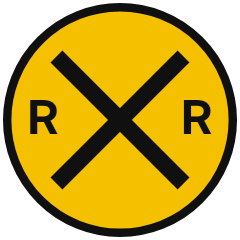
Show answer
Answer C: Slow down, look and listen for a train, and be ready to stop
The sign gives advance notice of a highway-rail grade crossing, so the driver reduces speed, checks both directions along the tracks and keeps enough room to stop short of the rails.
-
11. What is the correct order of a pass on a two-lane road?
Show answer
Answer A: Check ahead and behind, signal left, move out, accelerate past, signal right and return
A pass begins with the decision that the road is clear and ends with a signaled return, and each step warns other drivers before the vehicle moves.
-
12. Partway through a curve you realize you have carried in more speed than you wanted. What is the best response?
Show answer
Answer D: Look through the curve and lean the motorcycle further with steady throttle
Most motorcycles can lean further than the rider believes, and looking where you want to go while pressing the inside grip harder will usually bring the machine around.
-
13. Why is it risky to brake hard and steer sharply at the same moment?
Show answer
Answer C: The tires have a limited amount of grip that braking and turning must share
Each tire can deliver only so much grip, and asking it to slow the vehicle and change direction at once can exceed that limit and start a skid.
-
14. What is a microsleep?
Show answer
Answer D: A few seconds of sleep, sometimes with the eyes open
A microsleep is an involuntary lapse of a few seconds during which the driver is asleep and the vehicle travels blind, often without the driver knowing.
-
15. A center lane is marked with a broken yellow line on each side and is controlled by overhead lane signals. How is that lane used?
Show answer
Answer A: It carries traffic one way or the other according to the signals
A reversible lane is marked with broken yellow lines on both sides and its direction of travel is set by the lane control signals above it.
-
16. What should a rider understand about the horn on a motorcycle?
Show answer
Answer A: It is often weak and may not be heard, so it never replaces an escape route
A small horn competes with a closed car, a radio and traffic noise, so a rider plans a way out instead of trusting the horn to be heard.
-
17. With the chin strap fastened, how can you check that a helmet is the right size?
Show answer
Answer A: Try to roll it forward off your head, since a good fit will not come off
The roll off test shows whether the helmet will stay on in a crash. If it can be rolled off the front of your head with the strap done up, it is too big.
-
18. You are backing out of a space in a parking lot. Who has the right of way?
Show answer
Answer D: Traffic already moving in the lane, and pedestrians walking behind you
A driver backing out must yield to vehicles and pedestrians already using the lane, because backing is the movement with the poorest view.
-
19. Under Iowa's electronic device law, when may a driver use a phone while the vehicle is moving?
Show answer
Answer A: Only in a voice-activated or hands-free mode
Iowa Code section 321.276 bars using an electronic device while driving unless the vehicle is stopped off the traveled portion of the roadway, but a person does not violate the section when using the device in a voice-activated or hands-free mode.
-
20. Your phone is in a mount on the dashboard rather than in your hand. What is true?
Show answer
Answer B: It still takes your eyes and mind off the road
A mount solves the hand problem but not the eye or the mind problem, and reading or tapping a mounted screen costs the same seconds of attention.
-
21. The lane you are in is marked with a straight arrow and a right-turn arrow together. What does that mean?
Show answer
Answer D: Drivers in that lane may either go straight or turn right
A lane marked with two arrows serves both movements, so a driver in it may take either one.
-
22. How long must an ignition interlock device stay installed after reinstatement following a second Iowa revocation under the intoxication chapter?
Show answer
Answer A: One year
Iowa Code section 321J.17 requires the interlock device for one year from the date of reinstatement following a second or subsequent revocation, unless a longer period is required by statute.
-
23. As a general rule, how far should you travel along a center two-way left-turn lane before you turn?
Show answer
Answer C: Only a short distance, just enough to slow down and wait for a gap
The center lane is for making or preparing a left turn, so you enter it only shortly before the turn and never travel along it as a through lane; several states set a specific limit such as 200 or 300 feet.
-
24. Why does a passenger often feel the cold sooner than the rider on a long ride?
Show answer
Answer B: A passenger sits still and does not have the fuel tank to shelter behind
The rider has a screen or a tank to break the wind and is busy operating the machine, while a passenger sits exposed and inactive and chills faster.
-
25. A driver on a hands free call looks straight at a red light and drives through it. What best explains this?
Show answer
Answer B: The eyes saw it but the brain did not process it
Attention, not eyesight, decides what a driver actually sees, and a loaded mind can leave a driver looking straight at a hazard without registering it.