
Iowa DOT Motorcycle Practice Test 12
- Questions25
- Correct to pass20
- Passing score80%
- Minimum age14 years
-
1. Why is repeatedly changing lanes to work through heavy traffic a poor idea?
Show answer
Answer A: It raises the crash risk and saves almost no time
Each lane change adds a conflict with another vehicle, and in congestion the lanes move at similar average speeds, so the gain is negligible.
-
2. What kind of gloves are recommended for riding?
Show answer
Answer A: Full fingered gloves of leather or similar durable material
Full fingered leather or equivalent gloves improve grip on the controls and protect the hands, which riders instinctively put out in a fall.
-
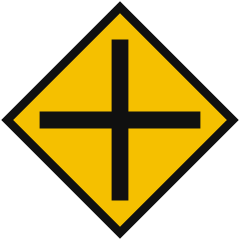
3. What should a driver expect a short distance beyond this sign?
Show answer
Answer C: Another road crossing the one being traveled
Traffic may enter or cross from either side at the intersection ahead, so the driver should ease off, cover the brake and check both approaches.
-
4. You are entering a freeway using an on-ramp with an acceleration lane. What is the correct technique?
Show answer
Answer C: Use the acceleration lane to reach the speed of traffic, then merge into a gap while yielding to traffic already on the freeway
The acceleration lane exists so you can match the speed of freeway traffic before merging, and drivers already on the freeway have the right-of-way.
-
5. At a rural intersection a beacon flashes yellow toward the main road and red toward the side road. How is each approach treated?
Show answer
Answer A: The main road slows and proceeds, the side road stops
An intersection control beacon assigns flashing yellow to the road with priority and flashing red to the approach that must stop and yield.
-
6. You are driving through a neighborhood where several children are riding bicycles. What should you do?
Show answer
Answer C: Slow down and expect sudden, unpredictable moves
Young riders lack the judgment and the mirror habits of adults and may swerve or cross without looking, so lower speed is your only reliable margin.
-
7. A pedestrian has stepped into a crosswalk at an intersection ahead of you. What is your obligation?
Show answer
Answer C: Yield and let the pedestrian finish crossing before you proceed
Drivers must yield to pedestrians in a crosswalk, and an intersection has a legal crosswalk whether or not lines are painted on the pavement.
-
8. A strong wind is blowing across an open stretch of road. Besides the gusts, what else should you watch for?
Show answer
Answer A: Branches, dust and loose objects blown into your path
High wind strips branches, litter and dust onto the roadway and can push other vehicles out of their lane, so scan much further ahead than usual.
-
9. You notice at night that one of your headlights has burned out. What should you do?
Show answer
Answer B: Get it replaced promptly, because other drivers may take you for a motorcycle
A single light makes your vehicle look narrower and further away, so other drivers misjudge you, and one light is also illegal.
-
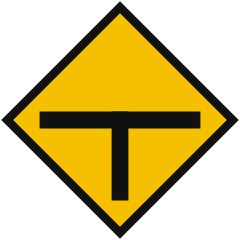
10. On which approach is this sign normally installed?
Show answer
Answer C: On the road that ends, far enough ahead for the driver to slow down
The warning belongs on the approach that terminates, placed early enough that the driver can lose speed and choose a direction before reaching the junction.
-
11. On a regulatory sign, what does a red circle with a diagonal slash drawn over a symbol mean?
Show answer
Answer D: The movement or action shown by the symbol is prohibited
A red circle with a diagonal slash is the standard way of showing that the movement pictured inside it, such as a U-turn or a right turn, is not allowed.
-
12. What is wrong with slowing to a crawl at a stop sign and then rolling on through?
Show answer
Answer C: It is not a stop, and you may miss a pedestrian or cross traffic
A rolling stop is a violation and it also cuts short the moment you need in order to look carefully in each direction before entering.
-
13. Some drivers believe they can multitask while driving. What does research show?
Show answer
Answer C: The brain switches rapidly between tasks and driving performance suffers
The brain does not truly do two attention-demanding tasks at once; it alternates between them, and the driving task gets less attention each time.
-
14. In near freezing weather, which part of an otherwise clear road is most likely to still be icy?
Show answer
Answer D: A shaded dip under trees or beside a rock cut
Sun clears most of the road, but shaded hollows never warm up and can hold ice long after the rest of the pavement is dry.
-
15. Why must the handlebars be kept square during a hard straight line stop?
Show answer
Answer B: Because a front wheel turned under heavy braking can put the machine down
With the front tire loaded to its limit, any steering input asks it to do two jobs at once and the front end can wash out instantly.
-
16. A sign showing a figure with an outstretched thumb inside a red circle with a slash means that
Show answer
Answer B: soliciting a ride is prohibited there
The no hitchhiking sign bars standing beside the road to solicit a ride, and it is common along freeway ramps and shoulders.
-
17. A row of solid white triangles points toward you across your lane. What does it mark?
Show answer
Answer A: The place to yield to traffic or people ahead
A yield line of triangles shows drivers exactly where to give way, and it is used at roundabouts and at midblock crosswalks.
-
18. You and an oncoming driver are both turning left at the same intersection. What is the usual rule?
Show answer
Answer D: Both turn in front of each other unless markings show otherwise
The normal practice is to pass driver side to driver side, turning in front of one another, unless pavement markings or signs direct a different path.
-
19. What is the purpose of a wide solid white line painted straight across your lane on the approach to an intersection?
Show answer
Answer C: It shows the point where a required stop must be made
A stop line indicates the point at which the stop required by a signal or a stop sign is to be made, ahead of the crosswalk and the intersection.
-
20. Do hazard lights make it legal to leave your vehicle in a no parking zone?
Show answer
Answer A: No, they warn other drivers but do not permit the parking
Hazard lights are a warning device, not a permit; the parking restriction applies whether they are flashing or not.
-
21. Where should a touring rider keep the rain suit?
Show answer
Answer B: Somewhere it can be reached quickly without unpacking everything
Rain gear only helps if you can get to it before you are soaked, so pack it where a quick roadside stop is enough to reach it.
-
22. The road ahead is broken up with potholes and rough patches. What should you do?
Show answer
Answer C: Slow down, since a hole hit at speed can wreck a tire or wheel
A lower speed cuts the impact on tires, wheels and suspension and gives you time to choose a line through the rough surface.
-
23. Why is parking against the flow of traffic dangerous even when nobody complains?
Show answer
Answer D: Because you had to cross traffic to get there and must cross again to leave
Parking on the wrong side means driving against traffic at both ends of the stop, and your reflectors and lights face the wrong way while you are there.
-
24. The divided highway ends warning sign means that
Show answer
Answer D: the median separating the directions ends and the road returns to two-way operation
Beyond this sign opposing traffic is no longer separated by a median, so the driver must keep right and expect vehicles approaching in the adjacent lane.
-
25. Why is a sign reading BRIDGE ICES BEFORE ROAD worth heeding even when the road itself is merely wet?
Show answer
Answer C: Cold air passes under a bridge as well as over it
A bridge deck loses heat from below as well as above, so it can be frozen while the road on either side of it is only wet.