
Iowa DOT Permit Practice Test 6
- Questions25
- Correct to pass20
- Passing score80%
- Minimum age14 years
-
1. As speed rises, which part of the total stopping distance grows the fastest?
Show answer
Answer B: The braking distance, which grows far faster than speed itself
Perception and reaction distances grow in step with speed, but braking distance grows roughly with the square of speed, so it dominates at higher speeds.
-
2. You are entering a freeway using an on-ramp with an acceleration lane. What is the correct technique?
Show answer
Answer C: Use the acceleration lane to reach the speed of traffic, then merge into a gap while yielding to traffic already on the freeway
The acceleration lane exists so you can match the speed of freeway traffic before merging, and drivers already on the freeway have the right-of-way.
-
3. Why are pedestrians and cyclists a special risk on unlit streets at night?
Show answer
Answer A: Dark clothing can make them invisible until they are very close
A person in dark clothing reflects almost no light and may not appear until they are inside your stopping distance, so cut your speed where people may be about.
-
4. The lane control signal above your lane changes to a steady yellow X. What should you do?
Show answer
Answer A: Prepare to leave the lane, because it is about to be closed
A steady yellow X is the warning that the lane below it is about to close, giving drivers time to move over before the red X appears.
-
5. When does Iowa require a motor vehicle on a highway to display lighted headlamps?
Show answer
Answer A: From sunset to sunrise, and when conditions hide people and vehicles at 500 feet
Iowa Code section 321.384 requires lighted headlamps from sunset to sunrise and whenever fog, snow, sleet or rain makes persons and vehicles indiscernible at five hundred feet ahead.
-
6. Under Iowa's electronic device law, when may a driver use a phone while the vehicle is moving?
Show answer
Answer A: Only in a voice-activated or hands-free mode
Iowa Code section 321.276 bars using an electronic device while driving unless the vehicle is stopped off the traveled portion of the roadway, but a person does not violate the section when using the device in a voice-activated or hands-free mode.
-
7. What is wrong with steering through a turn using the palm of one hand on the wheel?
Show answer
Answer D: You have less control and cannot correct quickly if something goes wrong
One-handed palming gives poor leverage and slow response. Use hand-to-hand or hand-over-hand steering with both hands so you can react instantly.
-
8. A sign on a long descent points to a RUNAWAY TRUCK RAMP a mile ahead. What is that ramp for?
Show answer
Answer C: Stopping a vehicle whose brakes have failed
An escape ramp climbs into deep gravel or sand to bring a vehicle with failed brakes to a halt, so no one should stop or park in it.
-
9. When should you adjust your seat, mirrors and steering wheel?
Show answer
Answer B: Before you start moving
Adjusting the driving position while moving takes your attention and often your hands away from driving. Make every adjustment while parked, every time.
-
10. Iowa classifies driver's licenses by letter. Which class authorizes operating a motor vehicle as a chauffeur?
Show answer
Answer B: Class D
Iowa Code section 321.189 defines a class D driver's license as valid for the operation of a motor vehicle as a chauffeur.
-
11. A yellow diamond reading DIP warns a driver about
Show answer
Answer A: a short, sharp depression in the road surface
A dip is an abrupt low point that can jolt a vehicle or scrape its underside, so speed should be reduced before reaching it.
-
12. On the Interstate system, what do the odd-numbered one and two digit routes have in common?
Show answer
Answer D: They run mainly north and south
Odd numbers are given to north and south Interstates and even numbers to east and west ones, with the numbers rising toward the north and the east.
-
13. You face a red light at an intersection that has no stop line and no marked crosswalk. Where must you stop?
Show answer
Answer C: Before entering the intersection
With no line and no crosswalk, the stopping point is the near edge of the intersecting roadway, close enough to see cross traffic but clear of it.
-
14. Your vehicle has a backup camera. What is the right way to use it?
Show answer
Answer C: Use it as an aid, but still turn and look behind you
A camera has a limited field of view and can be dirty or wet, so it supplements looking over your shoulder and using the mirrors rather than replacing them.
-
15. You are entering a marked school zone during the posted hours. What should you do?
Show answer
Answer A: Slow to the school zone limit and watch for children
The school zone limit applies throughout the posted hours, whether or not you can see any children at that moment.
-
16. A mixed drink is made with two shots of spirits. How much alcohol is that?
Show answer
Answer C: About two standard drinks
A standard drink is a fixed amount of pure alcohol, so a glass poured with two measures counts as two drinks however it is served.
-
17. Why should the shoulder belt never be worn under the arm or behind the back?
Show answer
Answer C: In a crash it could not hold your upper body and could cause severe injury
The shoulder belt restrains your chest and head. Placed under the arm it concentrates crash force on the ribs and organs; behind the back it does nothing at all.
-
18. You are already inside an intersection when you realize you should be in the lane beside you. What should you do?
Show answer
Answer C: Stay in your lane through the intersection and change lanes afterwards
Drivers in an intersection are watching for cross traffic and turning vehicles, so an unexpected sideways move there is easily missed.
-
19. Where should a rear-facing infant seat never be placed?
Show answer
Answer C: In a front seat with an active passenger air bag
A deploying front air bag strikes the back of a rear-facing seat with enormous force. Rear-facing seats belong in the back seat.
-
20. You have begun to move into the next lane when the gap you were aiming for closes. What is the safest action?
Show answer
Answer C: Return to your own lane, cancel the signal and wait for a better gap
An unfinished lane change leaves you in a space that no longer exists, and the lane you came from is still yours.
-
21. Which of these places should never be used to turn your vehicle around?
Show answer
Answer C: The driveway of a fire station or the roadway in front of it
Turning around in or in front of a fire station driveway can block emergency vehicles leaving, and most states prohibit it.
-
22. You are backing straight down a driveway while looking over your right shoulder. Where should your left hand be?
Show answer
Answer C: At the top of the steering wheel, holding it with a firm grip
With one hand at the top of the wheel you can hold a straight course and make small corrections while your body is turned to look behind.
-
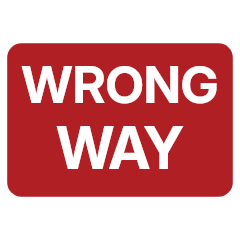
23. At a freeway exit ramp, this sign normally backs up which other regulatory sign posted nearer to the ramp terminal?
Show answer
Answer D: The sign that forbids entering that roadway at all
The two work as a pair at ramp terminals: one keeps drivers from turning in, and this one sits farther along to catch a driver who has already entered.
-
24. Which shape is used for the school advance warning sign and the school crossing sign?
Show answer
Answer B: An upward-pointing pentagon
The five-sided pentagon with its point up identifies school signing, so the outline alone tells a driver that children may be present.
-
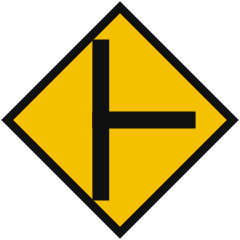
25. What condition does this sign warn a driver about?
Show answer
Answer B: Another road joins the road being traveled, from one side
It announces a side road entering the main roadway, so the driver should expect vehicles waiting to pull out and other vehicles slowing to turn in.