
Iowa DOT Permit Practice Test 46
- Questions25
- Correct to pass20
- Passing score80%
- Minimum age14 years
-
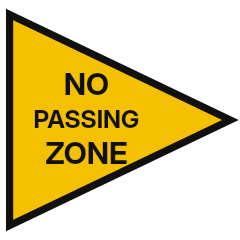
1. A driver is thinking about overtaking a slower vehicle and sees this sign a short distance ahead. What does it mean for that pass?
Show answer
Answer B: The pass must be finished before the restricted section begins
The sign marks the start of a section where passing is prohibited, so a driver may not be on the left side of the road beyond it; any pass has to be completed before that point or not started at all.
-
2. The motorcyclist ahead of you keeps moving from one side of the lane to the other. What should you understand?
Show answer
Answer B: The rider is avoiding surface hazards and staying where drivers can see the bike
Riders shift their lane position to avoid debris, grease strips and potholes and to be seen. That movement is normal and never an invitation to share the lane.
-
3. A pedestrian starts to cross against a Do Not Walk signal, right in front of you. What should you do?
Show answer
Answer D: Slow or stop and let the person reach safety
Even when a pedestrian is crossing unlawfully, a driver must take reasonable care to avoid hitting that person.
-
4. Your light turns green, but a vehicle from the cross street is still finishing a turn inside the intersection. What should you do?
Show answer
Answer B: Wait until that vehicle has cleared the intersection
A green indication lets you proceed only after yielding to pedestrians in the crosswalk and to vehicles already lawfully within the intersection.
-
5. What is the sensible way to handle a meal on a long drive?
Show answer
Answer D: Eat before you leave or stop to eat
Eating takes hands, eyes and attention, and the only version with no cost to your driving is the one that happens while the car is parked.
-
6. Which of the four blind spots around a tractor-trailer is the largest?
Show answer
Answer A: The one on the right side of the truck
A truck has no-zones on all four sides, and the right-side blind spot is the largest because it runs back along the trailer and reaches across more than one lane.
-
7. A bicyclist is riding in the middle of a narrow travel lane ahead of you. What is the correct response?
Show answer
Answer D: Slow down and wait until you can pass with wide clearance, changing lanes if needed
A bicyclist has the same right to use the lane as a driver, and a narrow lane may not leave safe passing room, so wait for a gap that lets you move over and pass with a wide margin.
-
8. When should most of your braking for a turn be finished?
Show answer
Answer B: Before you begin to turn the wheel
Slow to the right speed before the turn begins; braking hard while turning uses up the grip the tires need for steering.
-
9. A traffic signal ahead is showing a flashing red light. What does it require?
Show answer
Answer C: Stop completely, then go when the way is clear, as at a stop sign
A flashing red light has the same meaning as a stop sign: stop completely, yield to traffic and pedestrians, then proceed when it is safe.
-
10. You notice at night that one of your headlights has burned out. What should you do?
Show answer
Answer B: Get it replaced promptly, because other drivers may take you for a motorcycle
A single light makes your vehicle look narrower and further away, so other drivers misjudge you, and one light is also illegal.
-
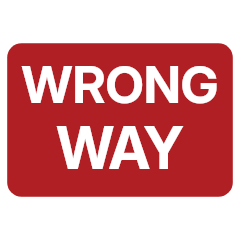
11. This sign comes into view ahead of a driver who has already started along a ramp. What should the driver do?
Show answer
Answer B: Pull clear where it is safe, then turn around and leave the ramp traveling properly
The driver is traveling against the legal flow, so the safest response is to stop clear of the lanes, turn the vehicle around and get off the ramp before meeting traffic head on.
-
12. Your vehicle is stuck in deep snow and you run the engine for heat while waiting for help. What must you check?
Show answer
Answer C: That the exhaust pipe is clear of snow
Snow packed around the tailpipe pushes exhaust back into the cabin, and carbon monoxide can kill without warning. Clear the pipe and crack a window open.
-
13. At a railroad crossing with no gates and no flashing lights, the crossbuck is normally combined with which sign?
Show answer
Answer C: A yield sign, or a stop sign where an engineering study calls for one
At a passive crossing the crossbuck forms an assembly with a yield sign, or with a stop sign when an engineering study or engineering judgment supports it, so the driver knows who must give way to the train.
-
14. What may an Iowa peace officer do when the driver of an Iowa-registered vehicle cannot produce proof of coverage?
Show answer
Answer C: Issue a warning, a citation, a citation with plate removal, or also impound the vehicle
Iowa Code section 321.20B gives the officer four options: a warning memorandum, a citation, a citation with removal of the plates and registration receipt, or that plus impoundment of the vehicle.
-
15. You have passed a large truck and want to move back into its lane. What should you see first?
Show answer
Answer B: Both of its headlights in your rear-view mirror
Seeing both headlights in your mirror means you are far enough ahead to be out of the truck's front no-zone before you move over.
-
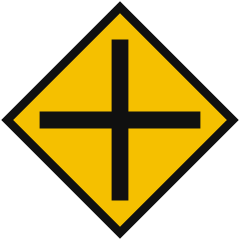
16. Does this sign settle who has the right-of-way at the intersection ahead?
Show answer
Answer D: No, it only gives notice of the intersection; the control there decides priority
A warning prepares the driver for what is coming but grants no priority, so whatever stop control, yield control, signal or right-of-way rule applies at the intersection is what decides.
-
17. How must a fifteen-year-old passenger be secured in an Iowa registered vehicle?
Show answer
Answer C: By a child restraint system, or by an approved safety belt or safety harness
Iowa Code section 321.446 requires a child at least six but under eighteen years of age to be secured by a child restraint system or by a safety belt or safety harness approved under section 321.445.
-
18. Loose items slide around your car and rattle every time you brake. What is the answer?
Show answer
Answer C: Secure them before you start driving
Sliding objects pull your attention and can roll under the pedals, so stow them in the trunk or wedge them before the trip rather than chasing them during it.
-
19. You are waiting to enter a two-lane roundabout and traffic is circulating in both lanes. What must you do?
Show answer
Answer A: Yield to traffic in both circulating lanes before you enter
Every entry to a roundabout is a yield point, and at a two-lane roundabout that means giving way to vehicles in either circulating lane.
-
20. How long does the Iowa DOT revoke a license after convictions on two charges of reckless driving?
Show answer
Answer A: Not more than thirty days and not less than five days, as the trial court recommends
Iowa Code section 321.212 provides that the department shall not revoke a license for two reckless driving convictions for more than thirty days nor less than five days, as recommended by the trial court.
-
21. You come upon a crash that has just happened and decide to help. Where should you stop your vehicle?
Show answer
Answer A: Well beyond the scene, completely off the road, with the hazard lights on
Stopping past the crash and off the pavement keeps you from becoming another victim and leaves the approach clear for emergency vehicles.
-
22. A center lane is marked with a broken yellow line on each side and is controlled by overhead lane signals. How is that lane used?
Show answer
Answer A: It carries traffic one way or the other according to the signals
A reversible lane is marked with broken yellow lines on both sides and its direction of travel is set by the lane control signals above it.
-
23. Your vehicle breaks down on a busy highway. What is the safest course of action?
Show answer
Answer D: Get it as far off the roadway as possible, switch on the hazard lights and keep clear of the traffic lanes
A vehicle left in or beside a travel lane is a hazard, so move it well off the road, make it conspicuous with hazard lights and keep yourself away from passing traffic.
-
24. Is dictating a message by voice a safe alternative to typing one?
Show answer
Answer C: No, it still takes attention from driving
Composing and checking a spoken message loads the mind and usually pulls the eyes to the screen anyway, so research finds it no safer than other phone use.
-
25. You are waiting in a center two-way left-turn lane. What should you expect from oncoming traffic?
Show answer
Answer A: Oncoming drivers may enter the same lane to prepare their own left turns
Both directions share a two-way left-turn lane, so an oncoming vehicle may be waiting in it and you must never treat it as yours alone.