
Iowa DOT Permit Practice Test 41
- Questions25
- Correct to pass20
- Passing score80%
- Minimum age14 years
-
1. A school sign combined with an AHEAD plaque, or with a plaque giving a distance in feet, forms an assembly that
Show answer
Answer B: warns of a school crossing located further along the road
The school advance crossing assembly is placed before the crosswalk to give drivers notice, while a different assembly marks the crossing itself.
-
2. A yellow lamp flashes above a warning sign at a sharp curve. What does it ask of a driver?
Show answer
Answer D: Slow down and pass the point with extra care
A warning beacon draws attention to the sign it is mounted with, and the message of the sign is what the driver must act on.
-
3. A wasp flies in through the open window while you are driving. What is the safest reaction?
Show answer
Answer B: Stay calm, slow down and stop somewhere safe
Far more crashes come from the driver's reaction to an insect than from the insect, so keep your eyes forward, slow down and deal with it stopped.
-
4. A vehicle coming toward you has drifted into your lane. What should you do?
Show answer
Answer D: Slow down, sound the horn, flash your lights and steer to the right if possible
Moving right gives the other driver space to recover and keeps you out of the lane they are most likely to return to. Braking reduces the force of any impact.
-
5. When should you arrange your way home if you plan to drink?
Show answer
Answer C: Before the first drink
Judgment is the first thing alcohol weakens, so the plan has to be made while you can still make a good one.
-
6. Another driver cuts you off and you feel your temper rising. What should you do?
Show answer
Answer A: Take a breath, drop back and let it go, because the whole trip matters more
Retaliation turns a moment of bad driving into a crash, and dropping back costs you only a few seconds.
-
7. In a work zone a flagger signals you to stop, but the sign beside the road says the lane is open. What should you do?
Show answer
Answer C: Obey the flagger
A flagger controls the work zone in real time and the instruction outranks the signs and markings, which cannot reflect what is happening at that moment.
-
8. How does a NO OUTLET sign differ from a DEAD END sign?
Show answer
Answer B: It warns that a whole group of streets has no way out
No Outlet is posted where the road leads into a network of streets from which there is no through route, while Dead End refers to the single street itself.
-
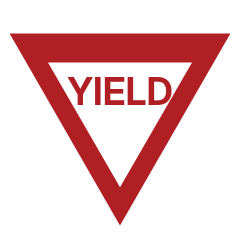
9. Apart from other vehicles, who else must a driver let go first at this sign?
Show answer
Answer A: Pedestrians and cyclists already in or entering the crossing
The duty to give way covers every road user who has the right of way at that point, including people walking or cycling across the driver's path.
-
10. What does a posted speed limit sign represent?
Show answer
Answer B: The maximum speed permitted under ideal conditions
A speed limit is an upper limit that assumes good weather, good visibility and light traffic, so the safe speed is often lower than the posted figure.
-
11. Freeway traffic ahead of you has come to a stop. Besides braking early, how can you warn the drivers behind you?
Show answer
Answer B: By switching on the hazard lights for a few seconds
A short burst of hazard lights is a recognized way to tell following traffic that the queue ahead has stopped, and it carries much further back than brake lights. Some states restrict hazard lights on a moving vehicle, so use them only for the moment you are slowing.
-
12. In plain words, what is oversteer?
Show answer
Answer C: The rear of the vehicle slides out and the car turns too sharply
Oversteer means the rear tires have lost grip first, so the tail swings out and the vehicle turns more than you asked it to.
-
13. Besides school signing, which warning signs may also use a fluorescent yellow-green background?
Show answer
Answer C: Pedestrian and bicycle warning signs
Pedestrian crossing, bicycle and playground warning signs may use either the standard yellow or the fluorescent yellow-green background, which draws extra attention where people outside vehicles are present.
-
14. You enter a corner faster than the turn can be taken. What is the most likely result?
Show answer
Answer A: The vehicle runs wide and may cross into another lane
Excess speed uses up the available grip, so the vehicle follows a wider arc than intended and drifts out of its lane.
-
15. You are driving in fog so thick that you can barely see the vehicle ahead. Which pavement marking is the best guide for staying in your lane?
Show answer
Answer A: The white edge line on the right side of the road
The right edge line keeps you positioned away from oncoming traffic and is easy to follow at low speed. Following tail lights closely tempts you to drive faster than you can see.
-
16. Lights set into the pavement along both edges of a crosswalk start to flash yellow as you approach. What do they tell you?
Show answer
Answer D: Someone is crossing and has to be given way
In-roadway warning lights flash only when a pedestrian activates the crossing, so a flashing pattern means somebody is in or entering the crosswalk.
-
17. You are the second vehicle waiting to turn left on a green ball. Where should you wait?
Show answer
Answer A: Behind the stop line, until the first vehicle has actually turned
Only the lead vehicle should move into the intersection to wait; a second vehicle inside it is likely to be stranded there when the light changes.
-
18. You are driving slower than the general flow on a multilane highway. Which lane should you use?
Show answer
Answer D: The right lane, keeping the left lanes free for faster traffic and passing
Slower traffic must keep right so that faster vehicles and overtaking traffic can use the left lanes without weaving between lanes.
-
19. A disabled vehicle is blocking your lane on a two-lane road with a single solid yellow line on your side. What should you do?
Show answer
Answer C: Wait until the oncoming lane is clear, then go around carefully
The solid line prohibits overtaking a moving vehicle, but in most states a driver may go around an obstruction such as a disabled vehicle once the oncoming lane is clear and the move can be made safely.
-
20. A sign at the start of an exit ramp shows a speed much lower than the highway limit. What does it apply to?
Show answer
Answer C: The curve of the ramp itself, once you have left the highway
The ramp speed is set by the sharpness of the ramp curve, so you slow to it inside the deceleration lane rather than out on the highway.
-
21. Why is a shoulder check especially important on a road with motorcycles and bicycles?
Show answer
Answer D: A narrow vehicle can disappear completely in the blind spot
A motorcycle or a bicycle is small enough to be hidden entirely by a door pillar or by the blind spot the mirrors do not cover.
-
22. You are approaching the entry of a modern roundabout. Who must you yield to?
Show answer
Answer C: Traffic already circulating in the roundabout, which approaches from your left
Traffic in a United States roundabout circulates counterclockwise, so drivers entering must look left and yield to vehicles already in the circulating roadway.
-
23. When is it acceptable to reach into the back seat for something while driving?
Show answer
Answer A: Never; stop somewhere safe instead
Twisting round takes your eyes off the road and your control of the wheel with it, so anything in the back seat waits until the car is stopped.
-
24. A notification appears on your smart watch while you are driving. What should you do?
Show answer
Answer B: Treat it as you would a phone and leave it
A watch screen demands the same eyes and the same attention as a phone, and a wrist is no safer a place to read a message than a dashboard.
-
25. You are first in the queue at a red light with a marked crosswalk. Where should your vehicle stop?
Show answer
Answer A: Behind the stop line, so that the crosswalk stays clear
Stopping short of the line keeps the crosswalk usable for people on foot and keeps your vehicle out of the path of turning traffic.