
Iowa DOT Permit Practice Test 4
- Questions25
- Correct to pass20
- Passing score80%
- Minimum age14 years
-
1. Which statement best describes what the basic speed law requires of you?
Show answer
Answer C: That you never drive faster than is reasonable and safe for the conditions
Nearly every state has a basic speed law that makes the conditions the real limit: weather, traffic, light and road surface can all require a speed well below the posted number.
-
2. Loose gravel has been swept into the middle of your lane on a downhill bend. Which controls are affected most?
Show answer
Answer D: Steering and braking, since the loose stones roll under the tires
Gravel rolls between rubber and pavement, so the tires can neither turn the vehicle nor slow it as they would on a clean surface.
-
3. Why is being thrown out of a vehicle in a crash so dangerous?
Show answer
Answer C: Because you strike the road or other objects at high speed, and rarely survive
Ejection is one of the deadliest outcomes of a crash, and a fastened belt is what keeps a person inside the vehicle.
-
4. You are turning left from a one-way street onto a two-way street. How should the turn be made?
Show answer
Answer B: Start in the far left lane and finish just to the right of the center line
Left turns begin from the lane nearest the left edge of the street you are leaving and must finish on the right-hand side of the center line of a two-way street.
-
5. Should you drive with your hazard lights flashing while moving in fog?
Show answer
Answer A: No, they hide your turn signals and suggest you are stopped
Hazard lights on a moving vehicle tell other drivers you are stopped or disabled, and they cancel out your turn signals just when clarity matters most.
-
6. Besides a chemical test, what else supports an impaired driving charge?
Show answer
Answer B: The officer's observations of the driving and the driver
Weaving, slow responses, speech and balance observed by the officer are evidence in their own right, which is why a driver can be charged on behavior alone.
-
7. A sign reads END SCHOOL ZONE. What does it tell a driver?
Show answer
Answer A: The regular limit for that road applies again
An end of restriction sign marks the downstream limit of a special zone, after which the ordinary speed limit for that road governs again.
-
8. Why does even a small reduction in speed matter so much where people are walking?
Show answer
Answer D: Because a pedestrian struck at a lower speed is far more likely to survive
The chance that a pedestrian survives falls steeply as impact speed rises, so a few miles per hour can decide the outcome.
-
9. How long should a young child ride in a rear-facing child seat?
Show answer
Answer D: Until the child outgrows the height or the weight limit of the seat
Rear facing is the safest position and should be kept until the child reaches the top height or weight allowed by the seat.
-
10. A stop line is painted across the pavement at this sign. Where must the vehicle come to rest?

Show answer
Answer A: Behind the stop line, with no part of the vehicle across it
The vehicle must halt behind the stop line; where no line is painted the driver stops before the crosswalk, and where there is neither, before entering the intersection.
-
11. You are driving at night through heavy falling snow. Which headlight setting works better and why?
Show answer
Answer C: Low beams, because high beams bounce off the falling flakes back at you
Falling snow reflects light the way fog does, so high beams build a white wall of glare while low beams still give a usable view.
-
12. You are driving on the through road of a T-intersection and want to turn left into the side road. Oncoming traffic is approaching on the through road. What must you do?
Show answer
Answer C: Yield to the oncoming traffic before you turn
The vehicle waiting in the stem of the T yields to both of you, but you still owe the right of way to oncoming through traffic before turning across it.
-
13. What fine does Iowa assess for a first operating while intoxicated conviction?
Show answer
Answer A: One thousand two hundred fifty dollars
Iowa Code section 321J.2 sets the first-offense fine at one thousand two hundred fifty dollars, part of which the court may waive if no injury resulted and the defendant obtains a temporary restricted license.
-
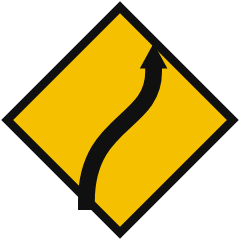
14. What does this sign tell a driver about the road ahead?
Show answer
Answer A: The roadway changes direction ahead, so speed should be reduced before reaching it
It gives advance notice of a change in alignment so the driver can slow down before entering, since braking inside a bend uses up grip that is needed for steering.
-
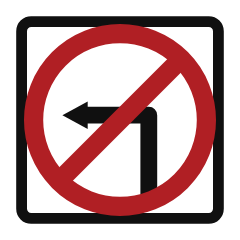
15. No plaque stating days or hours accompanies this sign at the intersection. When does the restriction apply?
Show answer
Answer D: At all times, since nothing limits it to particular periods
A regulatory restriction runs continuously unless a supplemental plaque states the days or hours during which it applies.
-
16. A diamond-shaped sign is used to
Show answer
Answer A: warn of a condition on or next to the road that may call for caution
The diamond is the standard shape of the warning series, which alerts drivers to conditions that would otherwise not be obvious in time to react.
-
17. Why is it risky to brake hard and steer sharply at the same moment?
Show answer
Answer C: The tires have a limited amount of grip that braking and turning must share
Each tire can deliver only so much grip, and asking it to slow the vehicle and change direction at once can exceed that limit and start a skid.
-
18. Why does a heavier vehicle need more room to stop than a light one from the same speed?
Show answer
Answer B: Because there is more mass in motion for the tires to slow down
More mass means more energy at the same speed, and the brakes and tires need more distance to get rid of it.
-
19. You have stopped after a crash. Why should the engines of the vehicles involved be switched off?
Show answer
Answer A: To reduce the risk of a fire starting around any fuel that has spilled
Crashes often break fuel lines, and a running engine is a source of ignition, so switching off lowers the risk of fire.
-
20. You correct a rear wheel skid and the back of the vehicle swings the other way. Why?
Show answer
Answer D: You steered too far, so be ready to correct back the other way
Over correcting sends the tail past straight and starts a second skid the opposite way. Steer smoothly and be ready to unwind the correction.
-
21. The lane you are in has a right-turn-only arrow painted on the pavement. What must you do?
Show answer
Answer C: Turn right, because a lane-use arrow is a legal requirement
Lane-use arrows painted on the pavement are regulatory markings, so a driver in that lane must travel in the direction shown.
-
22. At a freeway exit, the paved triangle between the ramp and the through lanes is filled with diagonal white lines. What do they mean?
Show answer
Answer A: Stay out of that area, because it is not meant to be driven on
Chevron and diagonal markings fill paved areas that traffic is not intended to use, so drivers should keep out of them.
-
23. A yellow pennant, an isosceles triangle with its long axis horizontal, is reserved for which message?
Show answer
Answer D: No passing zone
The pennant shape is used only for the no passing zone sign, which marks the point where overtaking is no longer allowed.
-
24. You feel dizzy and get a headache while driving with the windows closed. What could be the cause and what should you do?
Show answer
Answer D: An exhaust leak letting carbon monoxide into the cabin, so open the windows and stop to get fresh air
Carbon monoxide is colorless and odorless, and headache, dizziness and drowsiness are early signs. Get fresh air at once and have the exhaust system inspected.
-
25. You are passing a tractor-trailer on a wet freeway and its wheels throw heavy spray. What is the best technique?
Show answer
Answer B: Increase your wipers and pass steadily without hesitating
Spray blinds you for as long as you stay beside the truck, so prepare the wipers first and then spend as little time in the spray as possible.