
Iowa DOT Permit Practice Test 25
- Questions25
- Correct to pass20
- Passing score80%
- Minimum age14 years
-
1. A single solid white line separates two lanes running in the same direction. What is it telling drivers?
Show answer
Answer A: Changing lanes there is discouraged
A solid white lane line discourages lane changing, typically where merging or weaving would create a hazard.
-
2. Your light is green but the traffic beyond the intersection is stopped and there is no room on the far side. What should you do?
Show answer
Answer A: Wait behind the line until you can clear the far side
Entering an intersection you cannot clear blocks the cross traffic when their signal turns green, so you wait behind the line.
-
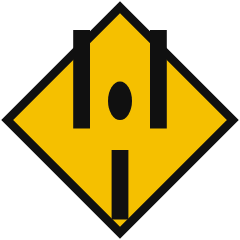
3. Beyond the point this sign refers to, which movement becomes unlawful?
Show answer
Answer D: Driving on the far side of the separation, against the flow
Once the two directions are separated, each roadway carries one-way traffic, so crossing to the other side means driving into oncoming vehicles.
-
4. You are traveling beside a tractor-trailer and cannot see the truck driver's face in any of the truck's mirrors. What does that tell you?
Show answer
Answer A: The truck driver probably cannot see your vehicle
Large trucks have deep blind spots on all four sides, so if the driver's face is not visible in a mirror the driver has no view of you. Move ahead or drop back until you are out of that area.
-
5. On a rural two-lane road you pass small blue signs, each naming one business with an arrow and a distance. What are they?
Show answer
Answer D: Tourist-oriented directional signs for traveler businesses
Tourist-oriented directional signs carry a white legend on blue and are used on rural conventional roads to guide travelers to eligible businesses.
-
6. What is the main limit of stability and traction control systems?
Show answer
Answer B: They cannot create grip that the tires and the road do not have
These systems manage the grip that exists. If you enter a curve too fast for the surface, no amount of electronics will hold the vehicle on the road.
-
7. You have fitted small convex blind spot mirrors to the door mirrors. What is true of them?
Show answer
Answer A: They help a good deal, but you should still look over your shoulder as well
Add-on mirrors reduce but do not remove the blind spot, and they make vehicles look smaller and further away.
-
8. What does a steady yellow traffic light tell the driver facing it?
Show answer
Answer A: The green movement is ending and a red indication is about to appear
A steady yellow warns that the related green movement is being terminated and that red will follow, so you should stop if you can do so safely.
-
9. You pull onto a soft grass verge to park. What is the main risk?
Show answer
Answer A: The wheels can sink and the car can slide toward the ditch
Soft ground gives way under the weight of a vehicle, and a car that settles or slides sideways can end up stuck or in the ditch.
-
10. Your phone is in a mount on the dashboard rather than in your hand. What is true?
Show answer
Answer B: It still takes your eyes and mind off the road
A mount solves the hand problem but not the eye or the mind problem, and reading or tapping a mounted screen costs the same seconds of attention.
-
11. An oncoming vehicle at night has its high beams on and you are being dazzled. Where should you look?
Show answer
Answer A: Toward the right edge of your lane
Looking toward the right edge line keeps you on course while sparing your eyes the worst of the glare. Slow down and do not retaliate with your own high beams.
-
12. Unless the restriction is waived by a parent or guardian, how many unrelated minor passengers may a new Iowa intermediate licensee carry during the first six months?
Show answer
Answer B: One
Iowa Code section 321.180B limits an intermediate licensee to one unrelated minor passenger for the first six months, unless a parent or guardian waives the restriction when the license is issued.
-
13. A vehicle ahead of you displays a reflective orange triangle on its rear. What does that emblem tell you?
Show answer
Answer B: The vehicle is built to travel at 25 mph or less
The orange triangle is the slow moving vehicle emblem used on farm and construction equipment designed for 25 mph or less, warning you that you are closing on it much faster than it appears.
-
14. An arrow panel in a work zone shows four flashing lamps in caution mode instead of an arrow. What does that display mean?
Show answer
Answer A: Warning only, so pass the work area with caution in your current lane
Caution mode gives a general warning without directing a lane change, so drivers stay alert and pass the activity with care.
-
15. The light turns yellow when your front wheels are already past the stop line inside the intersection. What should you do?
Show answer
Answer B: Keep going and clear the intersection without speeding up
Once you are legally in the intersection the safest and correct action is to continue through and clear it, without accelerating.
-
16. The traffic signal is green, but the crossing lights on the tracks inside the intersection begin to flash. What must you do?
Show answer
Answer C: Stop clear of the tracks and wait, even though the signal is green
Active crossing warning devices outrank the green indication, so you stop short of the rails and wait until the warning stops.
-
17. For how long after an Iowa driver's license expires may it be renewed without a driving test or written examination?
Show answer
Answer B: One year
Iowa Code section 321.196 makes a driver's license renewable without a driving test or written examination within a period of one year after its expiration date.
-
18. Your left-turn lane shows a flashing yellow arrow. What does that indication allow?
Show answer
Answer B: A left turn after yielding to oncoming traffic and to pedestrians
A flashing yellow arrow marks a permissive left turn: the movement is allowed, but oncoming vehicles and pedestrians keep the right-of-way.
-
19. Why is parking next to a fire hydrant or in a marked fire lane prohibited?
Show answer
Answer D: It would delay firefighters who need immediate access to the hydrant or the building
Fire hydrants and fire lanes must remain clear at all times so emergency crews can connect hoses and reach a building without delay.
-
20. How can you tell a tire has reached its wear limit without measuring it?
Show answer
Answer C: The wear bars across the grooves become level with the tread
Molded bars sit at the bottom of the grooves. Once the surrounding tread has worn down to them, the tire has reached the end of its safe life.
-
21. What minimum amount of railroad crossing safety instruction must an Iowa approved driver education course include?
Show answer
Answer C: Twenty minutes
Iowa Code section 321.178 requires a minimum of twenty minutes of instruction concerning railroad crossing safety within the classroom portion of the course.
-
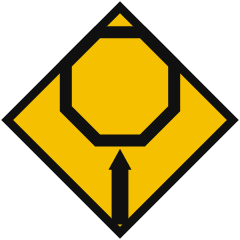
22. What is the driver expected to do after passing this sign?
Show answer
Answer A: Begin slowing so that a complete stop can be made at the intersection ahead
It is used where the control at the intersection stays hidden until late, so braking should begin here rather than at the stop line.
-
23. A vehicle in front of you has already begun turning left into a driveway when the gap you were waiting for opens up. What should you do?
Show answer
Answer B: Wait and let that driver finish the turn
A vehicle that has lawfully started a maneuver keeps the right of way until it is finished.
-
24. You are on a two-lane road where a broken yellow line runs on your side of the center. What does that pattern allow?
Show answer
Answer C: Passing when the way ahead is clear and it is otherwise legal
A broken yellow center line marks a stretch where passing is permitted for traffic on that side when it can be completed safely.
-
25. Which of these makes you unpredictable to other drivers?
Show answer
Answer B: Changing lanes suddenly without signaling, to save a moment
An unsignalled, sudden lane change gives nobody time to react and is a common cause of sideswipe collisions.